Cardamom
Discover the natural plants and herbs used in our products
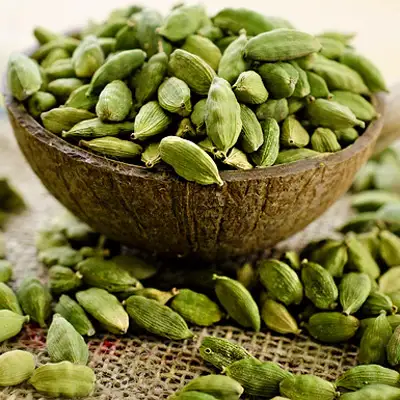
Cardamom
Cardamom is from ginger family and is recognized as the “queen of spices” for its pleasant aroma and taste. The herb has been used for treating various health problems like bronchitis, asthma, and constipation, cold, cough, carminative, teeth and gum infection, nausea, and cardiac disorders.
Benefits & Properties
Common Name: Cardamom, Green Cardamom
Scientific Name: Elettaria cardamomum (L.) Maton
History and Origin
The earliest reference to cardamom is a clay tablet from the ancient city of Nippur, Sumaria, dated 2000 BC. Cardamom was an article of trade between India and Greece during the 4th century BC. Cardamom was a natural forest product until the early 19th century, and its large scale organized cultivation started only in the mid 19th century when the demand for this herb increased worldwide. Nowadays its production is concentrated mainly in India and Guatemala. India has been the largest producer, consumer and exporter till 1980, but afterwards its position was taken over by Guatemala. In Guatemala the crop was introduced in 1920, and its production considerably expanded after World War Two due to high market prices and the drop of coffee prices. (1) Worldwide, cardamom is recognized as the “queen of spices” for its pleasant aroma and taste, and is the third most expensive spice after saffron and vanilla. In general, the cardamoms are the capsules of dried fruits in different genera of the Zingiberaceae family, primarily Elettaria, Amomum and Aframomum. Among them, Elettaria cardamomum (L.) Maton (2), which belongs to the genus Elettaria (1), is most important and Elettaria cardamomum (L.) Maton is commonly known as small cardamom, green cardamom, or true cardamom and is grown in India, Guatemala, Sri Lanka, Nepal, Indonesia, Costa Rica, Mexico and Tanzania. The botanical name of cardamom, Elettaria cardamomum, originated from the Tamil word “Elettari” which refers to its seeds . (2)
Cardamom Plant Structure
Cardamom is an herbaceous perennial plant that grows 2–5 m in height, with underground rhizomes and is propagated by vegetative division of rhizomes. The aerial stem is formed by encircling the leaf sheaths. The leaves are 30–35 cm long and 7–10 cm wide, lanceolate with acuminate tip. (2) Leaves are dark green and shiny on the upper surface and pale green on the lower surface. The lower surface of the leaf could be smooth (glabrous) or pubescent (hairy) depending on the variety. Flowers are borne in racemes, they are hermaphrodite, zygomorphic and about 4cm long and 1.5cm wide. The fruit is a trilocular capsule, ovate-globose, dark green to pale green in color. (1) Capsules (fruits) mature completely in about 120 days from flowering. (2) On ripening the capsule turns yellow in color; (1) The fruits are non-dehiscent, fleshy and leathery when dry. (2)
Each capsule contains 15-30 seeds which are dark brown, angled, aromatic and about 3mm long with a thin mucilaginous aril. (1)
The genus Elettaria has seven species and the small cardamom of commerce belongs to species cardamomum. Based on the nature of the plant, panicle, shape and size of fruits, three types of cultivated varieties can be recognized in India: var. Malabar, Mysore and Vazhukka. In the Malabar variety panicles are prostrate and 60-90 cm long: the fruits are small, globose, round or ovoid, pale green in color and are ribbed.
In the variety Mysore panicles are erect and capsules are bigger, longer, fusiform, three angled, dark green in color and ribbed. This variety is mainly cultivated in the Indian states of Kerala and Tamil Nadu.
In the variety Vazhukka panicles are semierect (flexuous) in nature. Capsules are bold, dark green in color, ovoid in shape, three-angled and ribbed. It is extensively cultivated in Guatemala. (1)
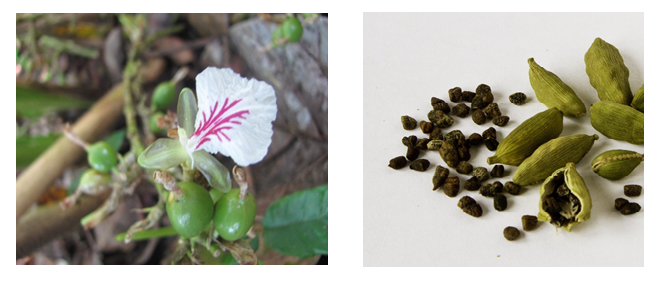
Fig. 1 Cardamom Flower, Fruits and Seeds
Cardamom Health Benefits
What Are Cardamom Side Effects?
No health hazards or side effects are known in conjunction with the proper administration of designated therapeutic dosages. (15)
1. When taken by mouth: Cardamom is LIKELY SAFE when taken in amounts commonly found in food. It is POSSIBLY SAFE when taken in the larger amounts found in medicine.
2. Pregnancy and breast-feeding: Cardamom is POSSIBLY UNSAFE when taken by mouth as a medicine during pregnancy. There is concern that taking cardamom might cause a miscarriage. There isn't enough reliable information to know if cardamom is safe to use when breast-feeding. Stay on the safe side and stick to food amounts.
3. Gallstones: If you have gallstones, do not take cardamom in amounts greater than those typically found in food. (16) It can trigger gallstone colic (spasmodic pain (16)), due to its motility-enhancing effect. (15)
Generally, every person may be allergic to certain herbs and spices. This sensitivity must be first diagnosed by the person and secondarily by the physician. However, these allergic reactions do not cause chronic or acute side effects, and after identifying the allergenic plant and removing it from diet, allergy-related complications will be eliminated. No company or product can be aware of the allergic reactions of different bodies in advance. The body's incompatibility with one or more specific herbs rarely occurs, but consumers may encounter it anyway.
Nutritional Information
The proximate composition of cured cardamom capsules includes carbohydrate 68.2%, protein 10.6 %, fat 2.4 % and ash 5.3 %. One hundred g of cured capsules contained calcium (93 mg), magnesium (182 mg), potassium (124 mg), phosphorus (183 mg), sulphur (100 mg) and iron (13 mg). These are essential mineral elements for normal day-to-day physiological activities of humans. (2)
Cardamom Daily Dosage
The average daily dosage is 1.5 gm seed. (15)
As a digestive: Infused 1 teaspoon of crushed seeds in 1 cup boiled water for 10-15 minutes. (17)
Bioactive Compounds
Cardamom capsules and leaves contain significant levels of manganese, zinc and copper. Nutritionally important metabolites of these capsules include flavonoids (catechin, myricetin, quercetin and kaempferol) and carotenoids (lutein and β-carotene). The essential oil content of the capsules varies from 6 to 14% depending upon the type and processing methods and possess predominantly monoterpene constituents, such as 1,8-cineole, α-pinene, α-terpineol, linalool, linalyl acetate and nerolidol and the ester constituent α-terpinyl acetate.
The characteristic aroma of cardamom capsules and seeds is principally developed by a combination of two major constituents namely 1, 8- cineole and α-terpinyl acetate. (2)
Best Time to Consume
1-2 hours before or after meals.
Possible Drug Interactions
1. Cardamom may increase the risk of bleeding when taken with drugs that also increase the risk of bleeding. Examples include aspirin, anticoagulants ("blood thinners") such as warfarin (Coumadin®) or heparin, anti-platelet drugs such as clopidogrel (Plavix®), and non-steroidal anti-inflammatory drugs such as ibuprofen (Motrin®, Advil®) or naproxen (Naprosyn®, Aleve®).
2. Medications changed by the liver: Cardamom may interfere with the way the body processes many drugs using the liver's "cytochrome P450" enzyme system. As a result, the levels of these drugs may be increased in the blood in the short-term (causing increased effects or potentially serious adverse reactions), and/or decreased in the blood in the long-term (which can reduce the intended effects). Examples of medications that may be affected by this herb in this manner include carbamazepine, cyclosporin, irinotecan, midazolam, nifedipine, birth control pills, simvastatin, theophylline, tricyclic antidepressants, warfarin, or HIV drugs such as non-nucleoside reverse transcriptase inhibitors (NNRTIs) or protease inhibitors (PIs).
3. Antispasmodic drugs or muscarinic agents: Cardamom may have antispasmodic effects. Patients taking antispasmodic drugs or muscarinic agents should use with caution.
4. Indomethacin: Although not well studied, it may also interact with indomethacin. (17)
Intake of following medications may also interfere with cardamom:
- Blood pressure-lowering drugs,
- Central nervous system (CNS) depressants: benzodiazepines such as lorazepam or diazepam, barbiturates such as phenobarbitals, narcotics such as codeine, some antidepressants and alcohol),
- Anaesthetics,
- Antibiotics,
- Anticancer Agents,
- Anticholinergics,
- Antifungals,
- Cyproheptadine,
- Diuretics (Loop),
- Estrogen,
- Pain relievers and
- Prednisolone. (18)
Traditional Use
Small cardamom capsules have been used since the 4th century BC by Indian Ayurveda doctors and ancient Greek and Roman doctors for treating various health problems such as bronchitis, asthma, and constipation, cold, cough, diuretic, carminative, teeth and gum infections, urinary and kidney disorders, congestion of lungs, pulmonary tuberculosis, and irritation of eyelids, and cataracts, nausea, diarrhea, and cardiac disorders.
Powdered capsules mixed with pulverized cloves, ginger and caraway have been used for digestive ailments. This powder drink is also an antidote for snake and scorpion venom. The consumption of these capsules reduces inflammation and headaches. This capsule powder is used for bronchial asthma patients with excess saliva and mucus in the respiratory tract, and as an excellent cough suppressant.
Cardamom capsules reduce the caffeine constituent in coffee and the combination of the capsules and coffee is called ‘gavah’ which is popular in Arabian culture to relieve headaches and stress.
In Chinese traditional medicine, this herb was used to treat constipation, stomach ache, bladder infections and dysentery in children.
Cardamom has also been widely used to treat food poisoning in Ayurveda medicine. In Indian traditional medicine, capsules are considered as excellent digestive. The seeds are chewed to avoid bad breath, vomiting and indigestion.
In Kerala and Tamil Nadu, crushed capsules are boiled with tea and water to impart a pleasant aroma to tea, which is popularly called “Elakkai tea” and which has been used to relieve tiredness due to over work and depression. (2)
Some Questions about Cardamom
References
1. https://www.eolss.net/Sample-Chapters/C10/E1-05A-49-00.pdf
4. http://www.discoveryjournals.org/medicalscience/current_issue/v23/n97/A23.pdf
5. http://nopr.niscair.res.in/bitstream/123456789/7254/1/IJBB%2046(6)%20503-506.pdf
6. http://www.mdpi.com/1422-0067/16/11/26040/pdf
7. https://www.ncbi.nlm.nih.gov/books/NBK209964/
8. http://www.bvmj.bu.edu.eg/issues/29-2/12.pdf
9. http://ijem.sbmu.ac.ir/browse.php?a_id=1920&sid=1&slc_lang=en
11. https://www.florajournal.com/archives/2018/vol6issue2/PartB/7-1-27-280.pdf
12. https://www.cancer.gov/publications/dictionaries/cancer-terms/def/chemoprevention
13. https://www.liebertpub.com/doi/10.1089/jmf.2011.0266
14. https://www.ncbi.nlm.nih.gov/pmc/articles/PMC3353705/
15. (2000). PDR for herbal medicines. 2nd ed. Montvale, NJ: Medical Economics Company.
16. https://www.webmd.com/vitamins/ai/ingredientmono-614/cardamom#
17. http://pspuok.com/books/monograph%20on/21.pdf
18. https://trialsjournal.biomedcentral.com/articles/10.1186/s13063-017-1979-3
20. https://kvkkodagu.iihr.res.in/Package%20of%20Practices/Cardamom%20(English).pdf
21. https://foodallergytest.co.uk/product/cardamom-allergy-test/
22. https://pubmed.ncbi.nlm.nih.gov/138507/#:~:text=Dermatitis%20from%20skin%20exposure%20to,terpenes%20present%20in%20the%20seeds.
23. https://bmccomplementmedtherapies.biomedcentral.com/articles/10.1186/s12906-017-2068-6
24. https://www.researchgate.net/publication/269560739_Pharmacological_basis_for_the_medicinal_use_of_cardamom_in_asthma