Hyssop
Discover the natural plants and herbs used in our products
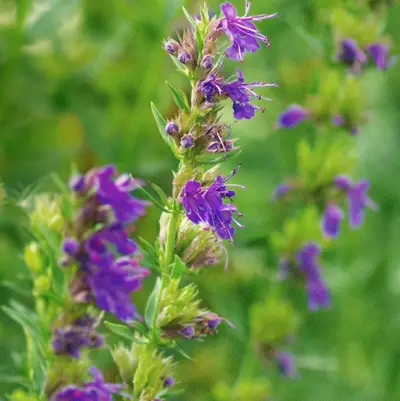
Hyssop
Hyssop tea traditionally is used to reducing inflammation, treat fever, rheumatism, and spasm. The plant improves food digestion and absorption.
Benefits & Properties
Common Name: Hyssop
Scientific Name: Hyssopus officinalis L.
History and Origin
Hyssop is an evergreen and perennial herb of the Lamiaceae family that its leaves are small and linear and its flowers are purple-blue. Hyssop is native to Mediterranean countries and mild regions of Asia but it is now widely cultivated around the world and is often used as a decorative plant. The origins of hyssop are Europe, the Mediterranean, North Africa, Syria, and Western Asia. Its growing site is Asia, the Mediterranean, Southern Europe, and Syria. Name of hyssop probably without any change is derived from Greek word of Hyssopus and the Hebrew word of ‘’Esob’’ means ‘’Holy plant’’.
Hyssop Health Benefits
1. Regulating Blood Glucose Levels
In 2008, a study was conducted on the inhibitory activity of medicinal plants against angiotensin (ACE) converting enzyme and digestive enzymes associated with diabetes and its results were published in Journal of Ethnopharmacology. Based on this study, it is indicated that hyssop extract is effective on alpha glucosidase enzyme. Enzymes of alpha-amylase and alpha-glucosidase are involved in glucose digestion and control the increasing blood glucose level after each meal.
Inhibitory property of alpha-glucosidase in aqueous-methanol extracts of dried leaves of hyssop was observed. In a study that was done in 2003 the inhibitory effect of alpha-glucosidase of hyssop extract on hyperglycemia (increasing blood sugar) in mice was evaluated and its results were published in Journal of Nutritional Science and Vitaminology (Tokyo). Based on these findings, 0.5 and 1 mg/ml of hyssop extract during 120 minutes inhibited excessive increasing of blood glucose level. Based on this, hyssop can be a helpful nutritional supplement for inhibition hyperglycemia after meal.
2. Relieving Muscle Spasms
In 2002, the relaxing effects of essential oil of hyssop and some of its main ingredients such as Isopinocamphone, Limonene and Beta-pinene on intestinal muscles of rabbit and guinea pig were studied and its results were published in Planta Medica. Essential oil and Isopinocamphone inhibited contraction caused by barium chloride and acetylcholine in ileum (part of the small intestine) of guinea pig in a concentration-dependent manner, while limonene or Beta-pinene had no effect on contraction of tissue. Also in ileum of guinea pig, essential oil of hyssop prevented contraction caused by calcium chloride CaCl2.
3. Boosting Immune System
In 2009, the antiviral activity of methanolic extract of hyssop leaves against of Herpes simplex viruses, type 1 (wild type) and type 2 (resistant strains) in laboratory condition and on animal model was investigated and its results were published in Journal of medicinal Plants Research. The extract of the plant increased the mean survival time in infected undertreated mice by 55-65% compared to untreated mice. Also mortality rate in mice treated with hyssop extract significantly reduced by 90% but mortality rate in untreated mice was 100%. These results have been shown that the extract of this plant has antiviral property against herpes simplex (HSV) and it can be an alternative treatment for infections of HSV. In the other research that its results were published in journal of Biochemical and Biophysical Research Communications, the extracted MAR-10 polysaccharide from hyssop, in a concentration-dependent manner, inhibited proliferation of HIV-1 virus. Based on this study, MAR- 10 polysaccharide contains antiviral strong activity of HIV-1.
4. Improving Respiratory Tract Function
In 2014, the effect of hyssop on inhibition of respiratory tract inflammation in mice with chronic asthma was investigated and its results were published in journal of Experimental and Therapeutic Medicine. For this purpose, 32 mice were divided into 4 groups: normal, with chronic asthma, under treatment with Dexamethasone and under treatment with hyssop. The results have shown that in the group with chronic asthma and under treatment with dexamethasone increased immunoglobulin E of serum (immunoglobulin E exacerbates asthma) in comparison to normal group and excessive airway mucus secretion was observed in these two groups. But the level of immunoglobulin E of serum in under treatment mice group with hyssop was similar to the results of normal group. Findings of this research have shown anti-inflammatory property of hyssop and its positive effect on breathing.
What Are Hyssop Side Effects?
1. When taken by mouth: Generally, no health hazards are known in conjunction with the proper administration of designated therapeutic dosages.
2. Pregnancy and breast-feeding: It is UNSAFE to use hyssop during pregnancy because it might cause the uterus to contract or start menstruation. These effects could lead to a miscarriage. It’s not known whether hyssop is safe to use during breast-feeding. Stay on the safe side and avoid use.
3. Children: It’s UNSAFE to give hyssop to children. Convulsions were reported in a child who took 2-3 drops of hyssop oil over several days.
4. Seizures: If you have a history of having seizures, don’t use hyssop. It might trigger seizures or make them worse.
The essential oil contains pino-camphone. This ketone can cause convulsions and seizures when taken in high doses. It is therefore not advisable to take hyssop oil and other hyssop preparations internally in high doses or over a longer time than two weeks.
* The herb may also trigger allergic reactions in those who are prone to allergies.
5. High blood pressure: Avoid use if you have high blood pressure and Epilepsy.
6. Iodine related conditions: The herb also has high Iodine content and should be avoided by those who suffer from iodine related health conditions.
Generally, every person may be allergic to certain herbs and spices. This sensitivity must be first diagnosed by the person and secondarily by the physician. However, these allergic reactions do not cause chronic or acute side effects, and after identifying the allergenic plant and removing it from the diet, allergy-related complications will be eliminated. No company or product can be aware of the allergic reactions of different bodies in advance. The body's incompatibility with one or more specific herbs rarely occurs, but consumers may encounter it anyway.
Hyssop Daily Dosage
The appropriate dose of hyssop depends on several factors such as the user's age, health, and several other conditions.
Adults 18 years and older can take 3 - 16 grams per day dried herb tops. Not to exceed 4 grams per single dose.
Bioactive Compounds
Pinocamphone, Apigenin, Luteolin, Quercetin derivatives, Phenolic acids such as Ferulic acid and Caffeic acid, Tannins, Monoterpenes (Cis-Pinocamphone, Trans-Pinocamphone, Beta-Pinene) and Sesquiterpenes (Germacrene D, Elemol).
Best Time to Consume
1-2 hours before or after meals.
Possible Drug Interactions
1. Antiepileptics: Hyssop may lower the seizure threshold, and theoretically may interact with antiepileptic medications.
2. Anti-hyperglycemics: Hyssop may interact additively with anti-hyperglycemic drugs.
3. Anti-hyperlipidemia drugs: Hyssop constituents oleanolic acid and ursolic acid have recognized anti-hyperlipidemic properties and may interact additively with anti-hyperlipidemia drugs.
4. Antivirals: Crude extracts of hyssop produced antiviral activity against herpes simplex and HIV-1. Therefore, hyssop may theoretically interact with antiviral medications.
5. Glucocorticoids: Decoctions which includes hyssop, may interact additively with glucocorticoids.
6. Immunosuppressants: Hyssop is proposed to possess immunomodulatory activity and may theoretically interact with immunosuppressant medications.
7. Medications that affect seizure threshold: Hyssop is proposed to affect the seizure threshold and may therefore theoretically interact with medications that affect the seizure threshold.
Traditional Use
Hyssop in traditional medicine is used as disinfectant and antibacterial, appetizer, analgesic and painkiller, expectorant, anti-flatulence and diuretic. Hyssop plant stimulates secretion of gastric juice and improves food digestion and absorption. Brewed dried leaves used to decreasing blood sugar, reducing inflammation, reducing spasm in straight muscle of digestive system and antimicrobial activity. Also this plant is used to treat fever, rheumatism, vomiting and spasm. Tea made from this plant is effective on remove neurological disorders and toothache.