Clove
Discover the natural plants and herbs used in our products
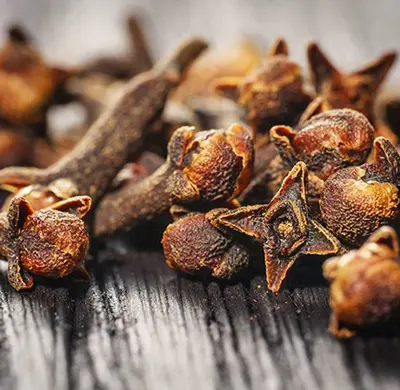
Clove
Clove is made from hand-picked and dried flower buds of Syzygium aromaticum. Today, ground clove is used as a spice and clove oil is used as a therapeutic drug.
Benefits & Properties
Common Name: Clove
Scientific Name: Syzygium aromaticum Merr. and L.M. Perry (L.)
History and Origin
Clove is made from a dried flower bud of evergreen tree of Syzygium aromaticum. Although this tree is native to Malacca Island in Indonesia but cloves naturally grow in India, Tanzania, Sri Lanka, Brazil, and Madagascar. Over 2000 years, clove and its oil have been used in traditional Indian and Chinese medicine. In the fourth century Arab merchants brought clove blossoms to Europe. During the seventh and eighth centuries clove was used as a food preservative in Europe. Today in many homes clove is used as spice and evidences suggest that its use as a therapeutic drug against harmful organisms is going to grow.
Clove Health Benefits
1. Improving Memory Function
In 2011 the effect of clove on learning, memory and modulating oxidative stress in laboratory mice was investigated and its results were published in journal of Planta Medica. Oxidative stress was evaluated by measuring the level of Malon di aldehyde (MDA) and decreased glutathione (GSH) in the brain. Initial treatment with clove oil at a rate of 1 and 5 (ml/kg) for 3 weeks significantly reduce delay in learning. Therefore, consumption of clove oil can reverse the short-term and long-term memory induced by scopolamine through reducing oxidative stress.
2. Improving Liver Function
Disorder in insulin function of diabetic patients leads to increase in liver glucose production. Recent studies have shown the effect of plants on increasing glucose absorption into lipid cells (like insulin function). Based on the results of a research in 2005 the clove extract has a similar function to insulin in liver cells and cells of liver tumor through reducing gene expression of enzymes of phosphoenolpyruvate carboxykinase (PEPCK) and glucose-6 phosphatase (G6Pase). More analyses have indicated that clove and insulin in a similar way adjust expression of many similar genes. These results emphasize on potential role of derived ingredients from clove as insulin-like factors.
3. Boosting Libido
In 2013 the effect of clove essential oil on improving the fertility of male rats exposed to manganese was considered and its results were published in journal of Advances in Sexual Medicine. Based on results essential oil extracted from the flower buds of clove improved sperm concentration and morphological abnormality caused by manganese.
Also, in 2004 in a research that its results were published in journal of BMC Complementary and Alternative Medicine, clove extract significantly improved the reproductive and sexual desire behavior of laboratory mice.
Of course it is worth noting that in a published research in journal of Food and Chemical Toxicology, the effect of three concentrations of hexane extract of flower buds of clove (15, 30 and 60 mg/kg of body weight) on laboratory mice testicular performance in a spermatogenesis cycle (35 days) was investigated and the results have shown that lower concentration (15 mg) of extract increased 17beta-HSD activity (the enzyme converting androstenedione to testosterone hormone) and delta5 3beta-HSD (progesterone biosynthesis catalytic enzyme) and testosterone serum level, but higher doses of extract (30 and 60 mg) inhibited the above items and reduced daily sperm production. According to these results researchers recommend to be more cautious in the use of clove to increase libido (sexual desire).
4. Anti-Microbial
The results of a research in 2005 that were published in Journal of Applied Toxicology showed that clove oil leads to protecting laboratory mice against Aflatoxicosis disease (caused by aflatoxin fungus).
Based on published information in Journal of Natural Products, clove ingredients inhibit activity of oral pathogens. In this research flavones, kaempferol and myricetin of methanolic extracts of clove have shown growth-inhibitory activity against the periodontal pathogens P. intermedia and P. gingivalis.
Also, the effect of extract of clove extracted on infected mice to type-1 herpes simplex virus (HSV-1) was studied and its result was published in Journal of Dermatological Science. Oral dose (750 mg/kg in a day) of this extract for ten days prevented the progression and relapses of HSV-1 disease and reduced the incidence of inflammation and severe erythema (skin redness) in comparison to control group.
5. Anti-cancer
Based on published study in Journal of Natural Products, bioassay-directed fractionation of clove terpenes leads to isolate five active ingredients that their names are beta-caryophyllene, beta-caryophyllene oxide, alpha-humulene, alpha-humulene epoxide I and eugenol. These ingredients increased detoxification enzyme activity of glutathione s-transferase in mice liver and small intestine. The ability of natural anticarcinogens to induce detoxifying enzymes has been found to correlate with their activity in the inhibition of chemical carcinogenesis.
What Are Clove Side Effects?
1. When taken by mouth: No health hazards or side effects are known in conjunction with the proper administration of designated therapeutic dosages.
2. Children: In children, clove oil is LIKELY UNSAFE to take by mouth. It can cause severe side effects such as seizures, liver damage, and fluid imbalances.
3. Pregnancy and breast-feeding: Clove is LIKELY SAFE when taken by mouth in food amounts. There is not enough reliable information about the safety of taking clove in medicinal doses if you are pregnant or breast-feeding. Stay on the safe side and avoid use.
4. Bleeding disorders: Clove oil contains a chemical called eugenol that seems to slow blood clotting. There is a concern that taking clove oil might cause bleeding in people with bleeding disorders.
5. Surgery: Clove oil contains a chemical called eugenol that seems to slow blood clotting. There is a concern that it might cause bleeding during or after surgery. Stop using clove at least 2 weeks before a scheduled surgery.
Generally, every person may be allergic to certain herbs and spices. This sensitivity must be first diagnosed by the person and secondarily by the physician. However, these allergic reactions do not cause chronic or acute side effects, and after identifying the allergenic plant and removing it from the diet, allergy-related complications will be eliminated. No company or product can be aware of the allergic reactions of different bodies in advance. The body's incompatibility with one or more specific herbs rarely occurs, but consumers may encounter it anyway.
Clove Daily Dosage
The World Health Organization (WHO) established that the daily quantity acceptable of clove per day is of 2.5 mg/kg of weight in humans.
Bioactive Compounds
Phenylpropanoids (such as Carvacrol, Thymol, Eugenol And Cinnamaldehyde); Phenolic acids such as Gallic acid ant its derivatives, Hydroxybenzoic acids, Caffeic acid, Ferulic acid, Salicylic acid and Hydroxycinnamic acids; Flavonoids (such as Kaempferol and Quercetin).
Best Time to Consume
1-2 hours before or after meals.
Possible Drug Interactions
Medications that slow blood clotting (Anticoagulant / Antiplatelet drugs): Clove might slow blood clotting. Taking clove oil along with medications that also slow clotting might increase the chances of bruising and bleeding. Clove contains eugenol. Eugenol is the part of clove that might slow blood clotting. Eugenol is very fragrant and gives allspice and clove their distinctive smell. Some medications that slow blood clotting include aspirin, clopidogrel (Plavix), diclofenac (Voltaren, Cataflam), ibuprofen (Advil, Motrin), naproxen (Anaprox, Naprosyn), dalteparin (Fragmin), enoxaparin (Lovenox), heparin and warfarin (Coumadin).
Traditional Use
From the remote past, clove had a medicinal and cooking application. Its oil was used as an expectorant, anti-nausea and vomiting with conflicting clinical outcomes. Clove is a traditional therapist for toothache relief, ear pain, blood pressure, pain caused by burns and wounds. In traditional medicine of China clove is known with the name of "ding xiang" or “nail-shape spice" and is used to treat indigestion, nausea, vomiting and infection. Clove is used to reduce toothache. In tropical Asia cloves were used to treat various infections such as malaria, cholera and tuberculosis.