Goat's Rue
Discover the natural plants and herbs used in our products
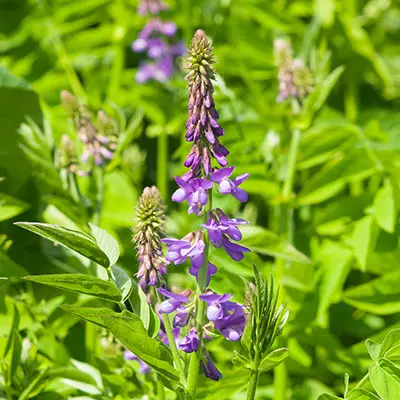
Goat's Rue
Goats’ rue (also known as Italian Fitch, French Lilac or Galega) belongs to the Fabaceae family. The aerial parts of the plant are used to manage the early stages of type 2 diabetes (T2D) or as part of its complementary treatment.
Benefits & Properties
Common Name: Goat's Rue
Scientific Name: Galega officinalis L.
History and Origin
Goats’ rue (also known as as Italian Fitch, French Lilac or Galega) belongs to the Fabaceae family. (1) This herb grows wild throughout Europe and Asia. (2) It prefers warm and humid regions. (3) The generic name, Galega, from the Greek word gala (milk) refers to the formerly widespread use of goat’s rue as fodder to increase the milk yield of cows. (4) The plant is odorless unless its leaves are bruised, whereupon it emits a disagreeable smell, which probably gave rise to the common name Goat's Rue. The medicinal parts are the leaves collected at the beginning of the flowering season and dried, as well as the tips of the flowering branches. (2)
Goat's Rue Plant Structure
Goats’ rue is the herbaceous perennial plant (1) that grows to about 1 m in height. The shrub has erect, branched, hollow stems. (2)
The plant has 1 cm long florets. The petals are bluish-white, (2) purple, and occasionally pink. They are borne on a structure called a raceme. (5)
The fruit is a round, indented pod containing many seeds.
The leaves are odd-pinnate; elliptical to lanceolate with a rich green upper surface and a lighter undersurface. (2) The leaf tastes bitter and astringent. (4)
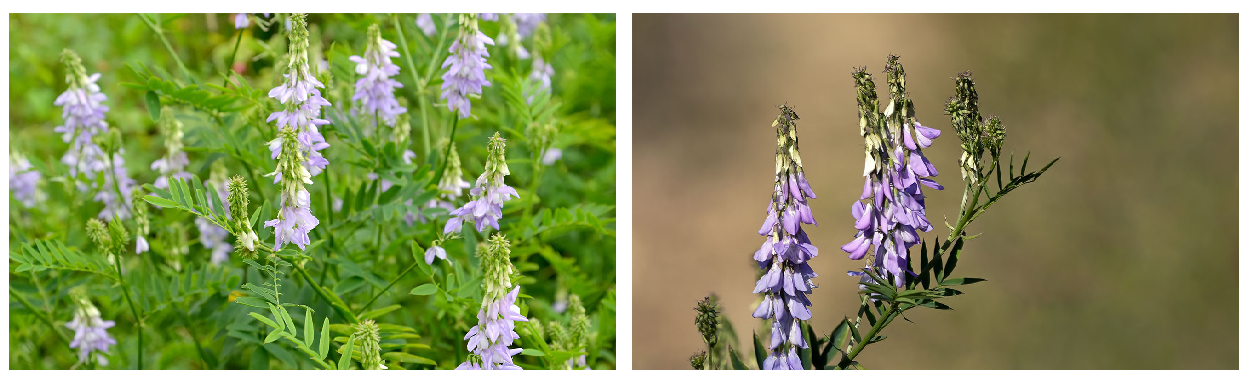
Goat's Rue Flowers and Leaves
Goat's Rue Health Benefits
What Are Goat's Rue Side Effects?
1. Pregnancy: There is not enough reliable information about the safety of taking goat's rue if you are pregnant. Stay on the safe side and avoid use. (23)
2. Breast-Feeding: Goat's rue is known as a galactagogue. Although some studies support this use, there is mixed reliable information about the safety of taking goat's rue if you are breast-feeding. (24)
- According to some, breastfeeding mothers should not use the fresh goat's rue plant. However, it is generally considered safe to use the dried plant leaves in tea. (25)
- On the other hand, according to two case reports, drinking more than 2 liters daily of a herbal tea mixture containing licorice, fennel, anise, and goat's rue to stimulate lactation, caused restlessness, vomiting, weak and lack of weight gain in two breastfed infants (younger than one month). However, both infants were doing well at 6 months of age. The authors attributed the infant symptoms to anethole, which is found in both anise and fennel, but not goat's rue.
Therefore, it is recommended that avoid drinking large amounts of goat's rue tea during lactation and consult with your healthcare professional before consumption. (24)
3. Bleeding conditions: Goat's rue might slow blood clotting and increase the risk of bleeding and bruising. In theory, goat's rue might make bleeding disorders worse.
4. Diabetes: Goat's rue might lower blood sugar levels in some people. Monitor your blood sugar carefully and closely if you have diabetes and use goat's rue.
5. Surgery: Goat's rue might affect blood sugar levels. It might interfere with blood sugar control during and after surgery. Stop using goat's rue at least 2 weeks before a scheduled surgery. (23)
6. Allergy to plants in the Fabaceae family: People who are allergic to other plants in the Fabaceae, including soybeans, peanuts, green peas, alfalfa, and fenugreek might also be allergic to Goat's rue. (25)
Generally, every person may be allergic to certain herbs and spices. This sensitivity must be first diagnosed by the person and secondarily by the physician. However, these allergic reactions do not cause chronic or acute side effects, and after identifying the allergenic plant and removing it from the diet, allergy-related complications will be eliminated. No company or product can be aware of the allergic reactions of different bodies in advance. The body's incompatibility with one or more specific herbs rarely occurs, but consumers may encounter it anyway.
Nutritional Information
In a study on the nutritional value of G. officinalis, it was determined that palmitic acid (a saturated fatty acid), linoleic acid (a polyunsaturated omega-6 fatty acid) and α-linolenic acid (a polyunsaturated omega-3 fatty acid) are the main fatty acids in the whole G. officinalis plant, and they represent 82%–85% of the fatty acids of the plant. Also, the omega 6/ omega 3 fatty acid ratio of the plant is steady at 0.13 during all stages of plant growth.
Analyses of the amino acid composition have confirmed the presence of all nine essential amino acids (including leucine, lysine, valine, phenylalanine, isoleucine, arginine, threonine, histidine, methionine) and non-essential amino acids (including aspartic acid, glutamic acid, alanine, glycine, proline, tyrosine, serine). (26)
Goat's Rue Daily Dosage
The therapeutic dose of goat's rue herb in humans recommended is 4 g per day.
Taking into account the usual daily doses of metformin (up to 3000 mg) in the treatment of T2D patients, the amount of guanidines (32 mg), at the dose of 4 g of Galegae herb recommended per day, appears to be safe. (6)
Bioactive Compounds
According to a 2020 study, goat's rue and its infusion are rich in polyphenols, quinazoline alkaloids and guanidine derivatives. Saponins, terpenes, steroids, and tannins, were also found in this plant.
Polyphenolics include:
- Flavonoids: mainly rutin.
- Hydroxycinnamic acids (HCAs): mainly monoferuloylhexaric acid isomers.
Quinazoline Alkaloids: predominant compounds include vasicine (peganine) and hydroxyvasicine (vasicinol).
Guanidines Derivatives: predominant compounds include galegine and hydroxygalegine. (6)
Best Time to Consume
Generally, 1-2 hours before or after meals.
For reducing blood glucose levels: one cup of goat's rue tea immediately after meals.
For breast-feeding: twice a day, preferably in the morning and early afternoon.
Possible Drug Interactions
Medications for diabetes (Antidiabetes drugs): Goat's rue might decrease blood sugar. Diabetes medications are also used to lower blood sugar. Taking goat's rue along with diabetes medications might cause your blood sugar to go too low. Monitor your blood sugar closely. The dose of your diabetes medication might need to be changed.
Some medications used for diabetes include glimepiride (Amaryl), glyburide (DiaBeta, Glynase PresTab, Micronase), insulin, pioglitazone (Actos), rosiglitazone (Avandia), chlorpropamide (Diabinese), glipizide (Glucotrol), tolbutamide (Orinase), and others.
Medications that slow blood clotting (Anticoagulant / Antiplatelet drugs): Goat's rue might slow blood clotting. Taking goat's rue along with medications that also slow blood clotting might increase the chances of bruising and bleeding.
Some medications that slow blood clotting include aspirin, clopidogrel (Plavix), diclofenac (Voltaren, Cataflam, others), ibuprofen (Advil, Motrin, others), naproxen (Anaprox, Naprosyn, others), dalteparin (Fragmin), enoxaparin (Lovenox), heparin, warfarin (Coumadin), ticlopidine (Ticlid), and others. (23)
Traditional Use
In traditional medicine, the aerial parts of goat's rue have been used to treat inflammatory diseases, (27) tuberculosis, malignant fevers, epilepsy, parasitic infections and various infectious diseases, and type 2 diabetes. Moreover, goat's rue was used as a galactagogue in lactating women. (6)
Some Questions about Goat's Rue
References
1.https://www.researchgate.net/publication/321168035
2. PDR for herbal medicines. (2000). 2nd ed. Montvale, NJ: Medical Economics Company
3. https://jmpb.areeo.ac.ir/article_122723_b191c56151544b67ad2e836e989715d1.pdf
4. https://www.motherearthliving.com/gardening/plant-profile/AN-HERB-TO-KNOW-48/
5. https://owlcation.com/stem/Goats-Rue-and-Metformin-Plant-Facts-and-Medication-Action
6. https://www.mdpi.com/1420-3049/25/24/5810/htm
7. https://www.researchgate.net/publication/316924946
8. https://d-nb.info/1153338521/34
9. https://www.researchgate.net/publication/318773339
10. https://www.sciencedirect.com/science/article/pii/S1347861319305535
11. https://www.ncbi.nlm.nih.gov/pmc/articles/PMC2579903
12. http://www.cjmb.org/uploads/pdf/pdf_CJMB_327.pdf
13. https://www.sciencedirect.com/topics/medicine-and-dentistry/galega-officinalis
14. https://journals.ekb.eg/article_168817_b0b255580631d3be93d4dabe64c9a814.pdf
15. https://www.minervamedica.it/en/journals/minerva-pediatrics/article.php?cod=R15Y2017N06A0531
16. https://onlinelibrary.wiley.com/doi/abs/10.1211/0022357991776895
17. https://www.ncbi.nlm.nih.gov/pmc/articles/PMC2438274/
18. https://onlinelibrary.wiley.com/doi/abs/10.1002/ptr.2650080514
19. http://www.uni-sz.bg/bjvm/vol6-no4-01.pdf
20. https://pubmed.ncbi.nlm.nih.gov/12422627/
21. https://www.ncbi.nlm.nih.gov/pmc/articles/PMC8398230/
22. https://www.academia.edu/33018132
23. https://www.rxlist.com/goats_rue/supplements.htm
24. https://www.ncbi.nlm.nih.gov/books/NBK501817/
25. https://www.verywellfamily.com/goats-rue-and-increasing-the-supply-of-breast-milk-431841
26. https://www.sciencedirect.com/science/article/abs/pii/S0377840106000174
27. https://www.researchgate.net/publication/303138365