Hawthorn
Discover the natural plants and herbs used in our products
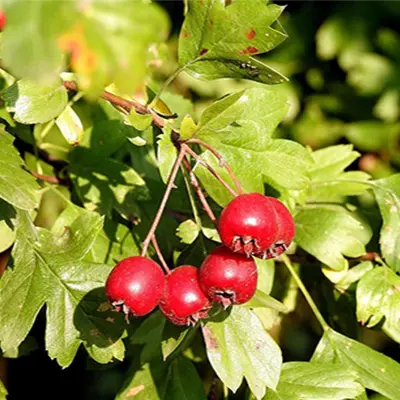
Hawthorn
All plant species in the genus Crataegus are known as hawthorn. Hawthorn is a widely used herb for preventing and treating cardiovascular diseases.
Benefits & Properties
Common Name: Hawthorn
Scientific Name: Crataegus microphylla C. Koch
History and Origin
All plant species in the genus Crataegus are known as hawthorn. Hawthorn belongs to the Rosaceae family and has about 280 species, (1) primarily from temperate regions of the Northern Hemisphere in Europe, Asia, and North America. (2-3) Its natural habitats are sunny and wooded areas on predominantly limestone soils up to 1500 m above sea level. (4) In Iran, some Crataegus species, including microphylla, generally grow in Hyrcanian forests. (2, 5)
Its leaves, flowers and fruits have medicinal properties. (2) Some hawthorn species, like microphylla, are grown for their edible fruit. (6-7) In many parts of the world, the fruits are consumed fresh or used to make jams, jellies, soft drinks, candies, canned fruits, and as a flavoring for dishes like white meats. (4, 8) Furthermore, Crataegus fruit is an important food source for many birds and small mammals throughout winter. Others that bear smaller, more insipid fruit are used to produce flowers, leaves, and fruit for medicinal purposes. (6) Some of them are officially listed in the pharmacopoeias of many countries such as China, Germany, France, and England.
Hawthorn was first mentioned for its use in traditional Chinese medicine (TCM) in Tang Ben Cao, the world’s first official pharmacopoeia published in 659 A.D. (1) Crataegus-derived medicines can take the form of tinctures, tablets, teas, and aqueous extracts of the plant’s leaves, flowers, and fruits. (6) Also, some Crataegus species are cultivated as ornamental plants. (9)
The name of the genus Crataegus comes from the Greek word “kràtaigos”, which means “strength and robustness” due to its hard and durable wood. (4)
Hawthorn Plant Structure
Species of the genus Crataegus are deciduous branched shrubs or small trees that are usually thorny. (4) They are mostly growing to 5–15 m tall. (2) The Leaf morphology, number of seeds and color of the fruits are highly diverse, depending on the species. The shape of its leaves is variable. (9) They are typically bright green (1) and have a straight or toothed edge. (10)
The flowers are small and arranged in clusters. (11) Each flower has five petals. The petals are white or pink. (9) The flowers develop at a time when the leaves have not reached normal size. (11)
The fruit, known as a “haw,” is small and similar to a berry and somewhat similar to plums. (2,9) It can be yellowish, reddish, blackish-purple, (9) black (10) or orange (11) and is usually fleshy. Each fruit has between one and five hard seeds. (9)
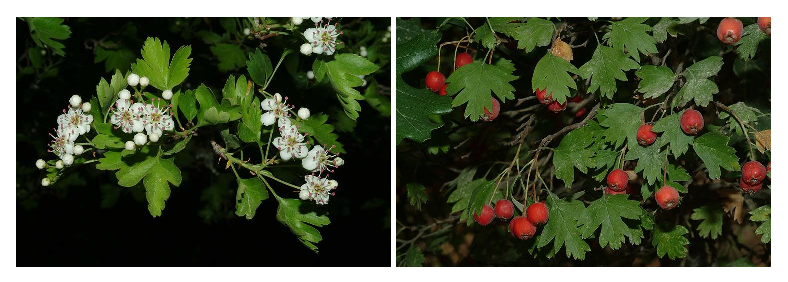
Hawthorn Flowers and Fruits
Hawthorn Health Benefits
What Are Hawthorn Side Effects?
When taken by mouth: Hawthorn is generally safe in recommended doses (23) for up to 16 weeks. (24) Overdose of hawthorn may cause symptoms that include dizziness, drowsiness, low blood pressure, and irregular heartbeats. (23)
It should be noted that hawthorn is a slow-acting herb and should be used for at least 4 to 8 weeks for full benefit. (1)
When applied to the skin: There isn't enough reliable information to know if hawthorn is safe or what the side effects might be.
Pregnancy and breast-feeding: There isn't enough reliable information to know if hawthorn is safe to use when pregnant or breast-feeding. Stay on the safe side and avoid use. (24)
Children: Its use in children is not recommended. (25)
Heart disease: Hawthorn can interact with many prescription drugs used to treat heart disease. If you have a heart condition, don’t use hawthorn without talking to your healthcare provider. (24)
Low blood pressure: If your blood pressure is low, don’t use hawthorn without talking to your healthcare provider. (4)
Liver disease: If you have liver problems, consult with your doctor before taking hawthorn. (26)
Surgery: Hawthorn might slow blood clotting. The concern is that it can increase the risk of bleeding during and after surgery. Stop using hawthorn at least 2 weeks before a scheduled surgery. (24)
Allergy to roses and related plants: Hawthorn may cause an allergic reaction in people who are sensitive to the Rosaceae family. If you have allergies, consult with your doctor before taking hawthorn. (26)
Generally, every person may be allergic to certain herbs and spices. This sensitivity must be first diagnosed by the person and secondarily by the physician. However, these allergic reactions do not cause chronic or acute side effects, and after identifying the allergenic plant and removing it from the diet, allergy-related complications will be eliminated. No company or product can be aware of the allergic reactions of different bodies in advance. The body's incompatibility with one or more specific herbs rarely occurs, but consumers may encounter it anyway.
Nutritional Information
In a study, the energy, protein, cellulose fiber, oil, and ash, values of hawthorn fruits were established as 34.02kcal/g, 2.48%, 4.67%, 0.87%, 2.28%, respectively. Also, the fruits contain high amounts of minerals including calcium (Ca), potassium (K), magnesium (Mg), sodium (Na), and phosphorus (P). (27)
Hawthorn Daily Dosage
The average daily dose is 5 gm of hawthorn fruit (haw). (3)
Bioactive Compounds
It is reported that the fruit of Crataegus spp. has high levels of flavonoid, vitamin C, glycoside, anthocyanin, procyanidins, saponin, tannin, and antioxidant levels, as well as other phenolic compounds. (6) The main compounds of Crataegus microphylla are flavonoids, triterpene, saponins, organic acids, and amines. Many of medicine characteristics of this species refer to flavonoids. (2)
Best Time to Consume
1-2 hours before or after meals.
Possible Drug Interactions
Medications that help the heart beat stronger / Medications that affect heart-muscle contraction: Hawthorn seems to affect the heart. Taking hawthorn along with these drugs might increase their effects and increase the risk of side effects. Some medications that strong heartbeat include dobutamine, milrinone, or digoxin (Lanoxin). (24, 26)
Medications for high blood pressure: Hawthorn might lower blood pressure. Taking hawthorn along with medications that lower blood pressure might cause blood pressure to go too low. Monitor your blood pressure closely. (24) Some medications that lower blood pressure include:
- Beta-blockers: They include Atenolol (Tenormin), Metoprolol (Lopressor, Toprol-XL), and Propranolol (Inderal, Inderal LA).
- Calcium channel blockers (CCBs): They include Norvasc (amlodipine), Cardizem (diltiazem), and Procardia (nifedipine). (25)
Medications that cause blood vessels to dilate (vasodilator agents), like nitrates: Hawthorn increases blood flow. Taking hawthorn with medications that also increase blood flow to the heart might increase the chance of dizziness and lightheadedness.
Medications for male sexual dysfunction (Phosphodiesterase-5 Inhibitors): Hawthorn might lower blood pressure. Some medications for male sexual dysfunction can also lower blood pressure. Taking hawthorn along with medications for male sexual dysfunction might cause blood pressure to go too low.
Medications that slow blood clotting (Anticoagulant / Antiplatelet drugs): Hawthorn might slow blood clotting. Taking hawthorn along with medications that also slow blood clotting might increase the risk of bruising and bleeding. (24) Some medications that slow blood clotting include aspirin, clopidogrel (Plavix), diclofenac (Voltaren, Cataflam, others), ibuprofen (Advil, Motrin, others), naproxen (Anaprox, Naprosyn, others), dalteparin (Fragmin), enoxaparin (Lovenox), heparin, warfarin (Coumadin), ticlopidine (Ticlid), and others.
Anti-inflammatory drugs: Medicines that help with swelling or inflammation can increase the risk of bleeding. Don’t take hawthorn along with anti-inflammatory drugs. Some medications for swelling or inflammation include nonsteroidal anti-inflammatory drugs (NSAIDs), aspirin, ibuprofen, and naproxen. (26)
Drugs that cause blood vessels to contract, like phenylephrine: According to a study, hawthorn fruit reduces the effects of phenylephrine, a medication that constricts blood vessels and is commonly found in nasal decongestant products. (25)
Also, if you are using any of the following medications, don’t use hawthorn without talking to your healthcare provider: Drugs that lower blood cholesterol levels, (28) Cardiovascular medications, Central nervous system (CNS) depressants, Vandetanib (Caprelsa, a medication for thyroid cancer (medullary type). (29)
Traditional Use
Traditionally, dried fruits of hawthorn are brewed as tea and consumed for the treatment of cardiovascular diseases like poor cardiac activity, cardiac pain, tachycardia (a heart rate that’s faster than normal), and atherosclerosis, throat infection, cough, renal diseases, hepatic pain, hemorrhoid, cancer, and diabetes. (10)
In Chinese traditional medicine, fruits of the Crataegus species are used to stimulate digestion, improve blood circulation, and treat diarrhea, abdominal pain, amenorrhea, hypertension, and hyperlipidemia. (7)
In Iran, the herb is traditionally used to help digestion and promote blood circulation. (2)
Some Questions about Hawthorn
References
1. https://accp1.onlinelibrary.wiley.com/doi/abs/10.1177/00970002042006003
2. https://citeseerx.ist.psu.edu/
3. PDR for herbal medicines. (2000). 2nd ed. Montvale, NJ: Medical Economics Company
4. https://pdfs.semanticscholar.org/
5. https://www.researchgate.net/publication/326662359
6. https://www.researchgate.net/publication/283987220
7. https://www.ncbi.nlm.nih.gov/pmc/articles/PMC7227902/
8. https://www.utupub.fi/bitstream/handle/10024/76646/
9. https://www.ncbi.nlm.nih.gov/pmc/articles/PMC8659235/
10. https://www.researchgate.net/publication/322921781
11. https://www.semanticscholar.org/paper/Hawthorn-(Crataegus-spp.)-from-botanical-source-to-Ada
12. https://www.sciencedirect.com/science/article/abs/pii/S0009279716303192
13. https://www.biotek.com/resources/white-papers/
14. https://www.verywellhealth.com/information-about-free-radicals-2249103
15. https://www.sciencedirect.com/science/article/abs/pii/S0009279721001678
16. https://academic.oup.com/mutage/article/24/3/233/1073832
17. https://link.springer.com/article/10.1007/s10495-014-1018-8
18. https://pubmed.ncbi.nlm.nih.gov/19157059/
19. https://www.researchgate.net/publication/6614316
20. https://pubmed.ncbi.nlm.nih.gov/21783835/
21. https://link.springer.com/article/10.1007/s00411-008-0190-z
22. https://pubmed.ncbi.nlm.nih.gov/20947657/
23. https://www.medicinenet.com/hawthorn/article.htm
24. https://www.webmd.com/vitamins/ai/ingredientmono-527/hawthorn#
25. https://www.mountsinai.org/health-library/herb/hawthorn
26. https://www.drugs.com/npc/hawthorn.html
27. https://www.sciencedirect.com/science/article/abs/pii/S0260877404003905
28. https://www.webmd.com/vitamins-and-supplements/hawthorn-uses-and-risks
29. https://www.rxlist.com/consumer_hawthorn/drugs-condition.htm
30. https://www.ncbi.nlm.nih.gov/pmc/articles/PMC3891531/