Hazelnut
Discover the natural plants and herbs used in our products
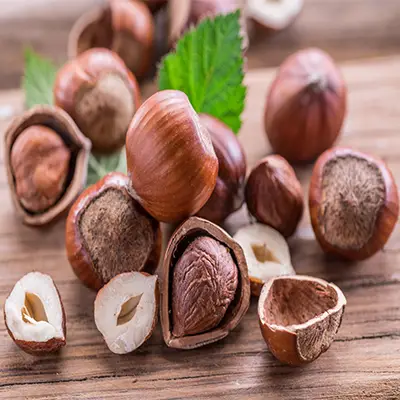
Hazelnut
Hazelnuts are trees or shrubs from the Betulaceae family. Hazelnut oil is a good source of omega-9 monounsaturated fatty acids, just like olive oil.
Benefits & Properties
Common Name: Hazelnut, Hazelnut Oil
Scientific Name: Corylus avellana L.
History and Origin
Hazelnut belongs to the Betulaceae family. (1) With an annual production of more than 863 thousand tons, hazelnut is one of the most valuable nut crops in the world, ranking third in the global nut market. (2)
More than a hundred varieties of hazelnuts are cultivated around the world. (3) Turkey is the world's top producer of hazelnuts, followed by Italy, Azerbaijan, the United States, China, Georgia, Iran, Poland, France, Spain, and Chile. More than 660,000 hectares of hazelnuts are harvested worldwide. (2)
Hazelnut is utilized in the cosmetics, pharmaceutical, and food industries, (4) as natural, blanched, and roasted or their products, such as sliced, chopped, flour, oil, and hazelnut butter, in order to provide flavor in chocolate, confectionery, candy, dairy, and bakery products. (5)
Hazelnuts often thrive in temperate climate regions with relatively high humidity and a high rainfall rate. (6) Hazelnuts are primarily found in the northern hemisphere and along the coasts of seas and oceans, where the climate is moderate in winter and cool in summer. (2)
Hazelnut is originally from North America, particularly the species C. americana and C. cornuta, and also from Asia Minor, particularly C. avellana. (7)
Iran is a major hazelnut grower around the globe. In Iran, hazelnut naturally grows mainly in Navan, Goli Dagh, Ashkorat, Alamut, Dinochal, Ardabil, and Tarem. (1)
Also, several hazelnut cultivars (8) are cultivated in a few regions of Iran with high relative humidity and high rainfall, as high relative humidity is crucial for producing high-quality hazelnuts. (1) Guilan, Mazandaran, and Ghazvin provinces have around 93 percent of the hazelnut cultivation areas in Iran and are regarded as the most important hazelnut production areas in Iran. (9) The hazelnut species mostly resemble shrubs and are rarely found as trees. (1)
The hazelnut cultivars show a high level of genetic diversity for traits such as vigor, growth habits, nut size and shape, and shell thickness. (10)
C. avellana is the most common hazelnut species. (7) Its name comes from the Italian town of Avella, when Carl Linnaeus described it as “Avellana nux sylvestris,” meaning the wild nut of Avella. (11)
Hazelnut Plant Structure
Hazelnut trees or shrubs, which may grow up to 6 m, (10) live 75–100 years, (11) and exhibit deciduous leaves 6–12 cm long, softly hairy on both surfaces, and with a double-serrated margin. (10)
Flowers are produced very early in spring, before the leaves, and are monoecious. Nuts develop in clusters of 1–12, each separately enclosed in a green leafy cover. A woody shell surrounds the kernel to protect it. (10) Before consumption, the leafy husk and the woody shell must be removed from the kernels. (11)
Hazelnut Oil Health Benefits
What Are Hazelnut Oil Side Effects?
When taken by mouth: Hazelnut is commonly consumed in foods. It’s usually well-tolerated, but some people are allergic to hazelnuts. Serious allergic reactions are possible. (27)
When applied to the skin: The potential risks and negative impacts of utilizing hazelnut oil for skin care are not well known. People who are allergic to nuts (like hazelnuts) avoid nut oils or any products containing them.
* Before using hazelnut oil, you should test for an allergic reaction, even if you are not allergic to nuts. A patch test on your skin is a simple way to accomplish this. (28) Apply a small amount of this natural oil to your forearm and wait for a few hours. If you experience any negative side effects, such as swelling, redness, itching, inflammation, rashes, or burning sensations, stop using the product. (29)
Pregnancy and breast-feeding: Hazelnut is commonly consumed in foods. There isn’t enough reliable information to know if hazelnut and its oil are safe to use as medicine while pregnant or breast-feeding. Stay on the safe side and stick to food amounts. (27)
Allergies: Hazelnut allergies can also occur in those who are allergic to cashews, walnuts, peanuts, Brazil nuts, macadamia nuts, birch pollen, or mugwort pollen. (27)
Generally, every person may be allergic to certain herbs and spices. This sensitivity must first be diagnosed by the person and secondarily by the physician. However, these allergic reactions do not cause chronic or acute side effects, and after identifying the allergenic plant and removing it from the diet, allergy-related complications will be eliminated. No company or product can be aware of the allergic reactions of different bodies in advance. The body's incompatibility with one or more specific herbs rarely occurs, but consumers may encounter it anyway.
Nutritional Information
Hazelnut has a significant impact on human nutrition and health due to its high nutritional value and special composition of fats, proteins, carbohydrates, dietary fiber, vitamins, minerals, phytosterols, squalene, and antioxidant phenols. (6)
One hundred grams of hazelnuts have 600–650 kcal. (5)
Hazelnut Oil Daily Dosage
Take one to two tablespoons (15 to 30 ml) per day directly or add it to a food, salad, or beverage.
Bioactive Compounds
According to research, the nutrient composition and content of hazelnut in different varieties or cultivars are very different. (6)
Fats: Hazelnuts are a good source of fat (50–73%) and contain saturated and unsaturated fatty acids, essential for human health. (5)
The fatty acids in hazelnuts decrease in the following order: oleic acid (omega 9), linoleic acid (omega 6), palmitic acid, stearic acid, and linolenic acid (omega 3).
Oleic acid is a mono-unsaturated omega-9 fatty acid found in different cultivars of hazelnut, with the highest content observed in cultivars from Italy, Portugal, and Poland. (2) Hazelnut also contains linoleic acid (omega 6) and linolenic acid (omega 3), which are poly-unsaturated fatty acids (PUFAs). Palmitic acid is the major saturated fatty acid, followed by stearic acid. (3)
Hazelnut cultivars with higher oleic acid concentrations and a higher "oleic acid to linoleic acid ratio" typically have longer shelf lives. (2, 6)
Protein: The protein content of this nut varies from 10% to 24%. It has been claimed that eating 100 g of hazelnuts per day could provide 22% of the daily protein requirement in the human diet.
Carbohydrate: Hazelnut includes carbohydrate at 10–22%.
Dietary fiber: Hazelnut contains pectins and celluloses at a rate of 1-3%.
Vitamins: Hazelnuts are a good source of vitamins, such as B1 (thiamin), B6 (pyridoxine), B3 (niacin), and E (α-tocopherol). (5)
Minerals: Hazelnuts are a valuable source of minerals, including magnesium, potassium, calcium, manganese, iron, zinc, phosphorus, and copper. (4)
Phytosterols: Hazelnut contains phytosterols including sitosterol, campesterol, and delta-5-avenasterol.
Phenols: Hazelnuts contain flavonoids (e.g., flavan-3-ols, catechin, epicatechin, myricetin-3-rhamnoside, and quercetin-3-rhamnoside); phenolic acids, including gallic, caffeic, ferulic, p-coumaric, and sinapic acids; condensed tannin; and stilbene (resveratrol).
It also contains organic acids, although in small amounts, and malic acid is the most abundant organic acid in hazelnut. (5)
Best Time to Consume
The best time to use hazelnut oil depends on your specific needs and preferences. For example, use it for cooking, skincare, haircare, aromatherapy, massage, or dietary purposes.
Possible Drug Interactions
Blood-thinning medicine: Hazelnut oil is high in vitamin E. If you use an oral blood thinner, you should also consult your doctor before using the oil. Too much vitamin E may intensify the medication's effects, resulting in increased bleeding and longer clotting times. (28)
Traditional Use
In some books on Persian medicine, it is specifically emphasized that hazelnut and almond protect the brain tissue and prevent brain atrophy, improving memory. (10)
Hazelnut oil is very effective against cholelithiasis.
Native Americans used hazelnut oil to treat tumors.
The literature also contains data on the use of hazelnut oil to treat ascarias. (30)
Some Questions about Hazelnut Oil
References
1. https://jmpb.areeo.ac.ir/article_127467_d8a3e902cc101303f134b73a31a2fbe7.pdf
2. https://www.mdpi.com/2077-0472/10/9/375
3. https://www.researchgate.net/profileOil_Goldenberry_Physalis_peruviana_L/
4. https://www.jstage.jst.go.jp/article/jos/68/2/68_ess18216/_html/-char/ja
5. https://upload.wikimedia.org/wikipedia/commons/1/10/Las_cracteristicas_de_la_johanna.pdf
6. https://www.ncbi.nlm.nih.gov/pmc/articles/PMC8261296/
7. http://www.ijfe.org/uploadfile/2020/1203/20201203051317165.pdf
8. https://www.sciencedirect.com/science/article/abs/pii/S0304423812005572
9. https://ijnrs.damghan.iau.ir/article_540861_f64dff2a9f98bbe27625a11231c1a545.pdf
10. https://www.thieme-connect.com/products/ejournals/pdf/10.1055/a-0947-5725.pdf
11. https://www.sciencedirect.com/science/article/abs/pii/B9780128181881000207
12. https://pubmed.ncbi.nlm.nih.gov/19291034/
13. https://tspace.library.utoronto.ca/bitstream/1807/6584/1/jb05007.pdf
14. https://www.scielo.br/j/rbfar/a/dMxp6RwGML95v5TYkLrbrdP/
15. https://www.ncbi.nlm.nih.gov/pmc/articles/PMC4066722/
16. https://ijrr.com/article-1-578-en.html
17. https://www.ejmoams.com/ejmoams-articles/lipid-peroxidation-types-and-its-determination.pdf
18. https://pubmed.ncbi.nlm.nih.gov/12797764/
19. https://pubmed.ncbi.nlm.nih.gov/15765761/
20. https://pubmed.ncbi.nlm.nih.gov/15502349/
21. https://www.mountsinai.org/care/heart/services/aortic/what-is
23. https://www.hopkinsmedicine.org/health/conditions-and-diseases/atherosclerosis
24. https://www.webmd.com/heart-disease/what-is-atherosclerosis
25. https://link.springer.com/article/10.1186/2251-6581-12-13
26. https://journals.tubitak.gov.tr/cgi/viewcontent.cgi?article=1894&context=biology
27. https://www.webmd.com/vitamins/ai/ingredientmono-865/hazelnut
28. https://www.healthline.com/health/beauty-skin-care/hazelnut-oil-for-skin#how-to-use
29. https://www.stylecraze.com/articles/hazelnut-oil-for-skin/
30. https://scholarworks.umass.edu/cgi/viewcontent.cgi?article=1093&context=jmap
31. https://thisisfeel.com/blogs/blog/non-comedogenic-oils
32. https://en.pasargadnuts.com/blog/14/hazelnut-properties-and-its-therapeutic-and-medicinal-benefits-for-the-body
33. https://www.byrdie.com/hazelnut-oil-for-hair-5219668
34. https://gratusnaturals.store/product/hazelnut-oil-benefits/