Sweet Almond
Discover the natural plants and herbs used in our products
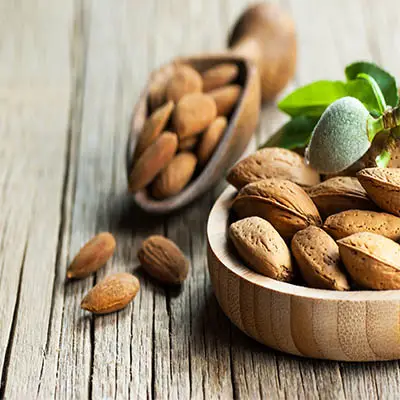
Sweet Almond
Sweet almond is a tree from the Rosaceae family. Sweet almond oil, made from pressed almonds, is a good source of vitamins E, especially the α-tocopherol.
Benefits & Properties
Common Name: Sweet Almond, Sweet Almond Oil
Scientific Name: Prunus amygdalus var. dulcis (Borkh. ex DC.) Koehne
History and Origin
The almond tree is a species that belongs to the Prunus genus and the Rosaceae family. The almond kernel has been used as a nutrient-dense food for mankind.
Apparently, it originated from one or more wild species that evolved in the deserts and mountain slopes of central and southwestern Asia. Almonds were among the first plants to be domesticated. The earliest archaeological evidence suggests that this occurred in Jordan. Almonds are the most important nut in the world in terms of commercial production. (1)
Almonds are considered worldwide to be the most pleasant and consumed tree nut, with applications in the food, cosmetic, and pharmaceutical industries. (2) Likewise, the demand for almond oil is on the rise globally due to the oil’s health benefits and high nutritional value. The rise in demand for aromatherapy products and the growing use of almond oil in cosmetic formulations, which is due to an increase in preferences for natural ingredients, are the primary factors that drive the global almond oil market. (1)
The production of almonds has increased dramatically globally during the last ten years, according to the Food and Agriculture Organization (FAO). (2) The United States, Spain, and Australia are the top producers, followed by Iran, Morocco, Italy, Syria, Turkey, and Tunisia. (1)
Wet climates are not suitable for growing almonds because of their sensitivity to moisture. This tree prefers a Mediterranean climate, and it is often cultivated in the temperate zone. (3) Almond is grown in the whole Mediterranean region, in California, in northwest Mexico, in a small part of Australia, and in other areas around the world. (1)
Sweet Almond Plant Structure
Almonds are deciduous trees or shrubs of varying size and shape (2) with mildly red-tinged branches, thorny in their wild form but not in their cultivated form. The leaves are glabrous, oblong-lanceolate-acuminate or serrate, tough, glossy, and dark green. The flowers are pale pink or white. The ripe fruit is the medicinal part. The fruit is oblong-ovoid, compressed, gray-green, and velvety-downy. The nut shell is hard and compressed. The seed is cinnamon brown and 2 cm long by 1.2 to 1.5 cm wide. (4)
Almond has considerable genetic variability around the world. Based on taste, two major varieties were identified: the bitter almond (“amara” variety) and the sweet almond (“dulcis” variety). Almonds are characterized as sweet or bitter, depending on the amount of amygdalin in the kernel. (2) The fixed sweet almond oil comes exclusively from edible almonds (Prunus amygdalus var. dulcis). Sweet almond oil is a pale-yellow liquid with a nutty taste.
Fresh sweet almond oil, extracted using pressing, shows low contents of free fatty acids, peroxides, and phosphatides, and therefore it can be consumed directly and used for culinary purposes (mainly as a salad dressing and vegetable dips) without refining as a 100% virgin product. (1)
Sweet Almond Oil Health Benefits
What Are Sweet Almond Oil Side Effects?
- When taken by mouth: Sweet almonds are often ingested orally as food. To determine whether sweet almonds are safe to use as medication, there is insufficient trustworthy information available. (21)
- When applied to the skin: Sweet almond oil is suitable and safe for any skin type. (1) If you have acne-prone skin, check with your healthcare provider before applying this oil directly to your face. (22)
Irritable bowel syndrome (IBS): Consuming excessive quantities of sweet almond oil may worsen diarrhea and pain in patients with IBS. (21)
- Pregnancy and breast-feeding: Please discuss the benefits and risks with your healthcare provider before taking sweet almond oil. (23)
- Diabetes: Some people may have a decrease in blood sugar after eating sweet almonds. Keep an eye out for symptoms of hypoglycemia, use sweet almonds, and closely check your blood sugar if you have diabetes.
- Surgery: In some cases, sweet almonds may reduce blood sugar. Theoretically, blood sugar regulation both during and after surgery may be impacted by sweet almonds. At least two weeks before a planned operation, stop consuming sweet almonds. (24)
- Allergy to almond oil: The oral and topical use of sweet almond oil is generally safe for people. Anyone who has a severe nut allergy should not use the oil topically (on their hair and skin) or orally because it may cause a serious allergic response. (24)
Generally, every person may be allergic to certain herbs and spices. This sensitivity must first be diagnosed by the person and, secondarily, by the physician. However, these allergic reactions do not cause chronic or acute side effects, and after identifying the allergenic plant and removing it from the diet, allergy-related complications will be eliminated. No company or product can be aware of the allergic reactions of different bodies in advance. The body's incompatibility with one or more specific herbs rarely occurs, but consumers may encounter it anyway.
Nutritional Information
The primary nutritional components of almonds are lipids, which consist of a variety of fatty acids, including SFAs, MUFAs, and PUFAs, as well as oil-soluble substances, including squalene, phytosterols, tocopherols, and tocotrienols. (2)
Sweet Almond Oil Daily Dosage
Take one to two tablespoons (15 to 30 ml) per day directly or add it to a food, salad, or beverage.
Bioactive Compounds
Fatty acids: Only 8% of the fatty acids in almond oil are saturated fats (palmitic acid and stearic acid (25)), while it is high in monounsaturated fats. (1) Oleic acid (omega-9) and linoleic acid (omega-6) are the most important unsaturated fatty acids found in almond oil. (7)
* Oleic acid, which makes up between 50 and 70 percent of the total fatty acid content of almond oil, is the main fatty acid. (1)
Phytosterols: Almond oil was found to have an important amount of phytosterol content. β-sitosterol is identified as the major phytosterol in almond oil. (2)
Tocopherols and tocotrienols:Vegetable oils are the major sources of vitamin E, which includes tocopherols (α-, β-, γ-, and δ-tocopherol) and tocotrienols (α-, β-, γ-, and δ-tocotrienols)—that also have antioxidant properties. (2) Sweet almond oil contains large amounts of vitamin E, (1) especially α-tocopherol, which is the most biologically active form of vitamin E. (7)
Best Time to Consume
Basically, you can consume sweet almond oil any time of the day. The best time depends on why you are using the oil. For example:
- To control blood sugar levels: According to a study, consuming a breakfast with added sweet almond oil had lower blood sugar levels both after the meal and throughout the day. (7)
- To relieve scalp itching and flaking: Massage sweet almond oil into your scalp and let it sit for at least an hour before a bath. (26)
- To strengthen your hair: Apply sweet almond oil to your hair a few hours before you wash it and let it sit on your scalp. (27)
- For constipation: Take sweet almond oil with moderately warm milk at bedtime.
Possible Drug Interactions
Medications for Diabetes (Antidiabetes Drugs): Sweet almonds may help some individuals reduce their levels of blood sugar. Additionally, blood sugar levels can be lowered using diabetes medication. Taking sweet almonds with diabetic medication may cause your blood sugar to drop dangerously low. Pay close attention to your blood sugar levels. You may need to change the dose of your diabetes medication. Among the medications used to treat diabetes are glimepiride (Amaryl), insulin, rosiglitazone (Avandia), glyburide (DiaBeta, Glynase PresTab, Micronase), glipizide (Glucotrol), tolbutamide (Orinase), pioglitazone (Actos), and others. (24)
Traditional Use
Almond is used as an emollient, lithontryptic, demulcent, diuretic, carminative, astringent, laxative, and tonic in traditional medicine. Almond is a traditional cure for ulcers and heartburn.
The kernels are added to the diet to prevent peptic ulcers. (3)
The ancient Greek doctors Hippocrates and Galen described almonds as "hot" and noted their "heating," "cleansing," "nourishing,” and “strengthening mental function” properties. (1)
Sweet almond oil is used to flavor baked foods and perfumes. (3)
Also, the oil had been used traditionally to treat dry skin conditions such as psoriasis and eczema. (28) The ancient Romans used sweet almond oil extensively in skincare products. Sweet almond oil was also embraced as a beautifier in Europe as early as the 16th century. (3) Massage therapists have been using this oil, which many believe to be an excellent emollient, to lubricate the skin during a massage session. (28)
Some Questions about Sweet Almond Oil
References
1. https://www.researchgate.net/publication/332957892_Almond_Prunus_dulcis_oil
2. https://ift.onlinelibrary.wiley.com/doi/abs/10.1111/1541-4337.12752
3. http://researchjournal.co.in/upload/assignments/1_147-151.pdf
4. PDR for herbal medicines. (2000). 2nd ed. Montvale, NJ: Medical Economics Company
5. https://downloads.hindawi.com/journals/bmri/2022/9661939.pdf
6. https://www.ijmrhs.com/medical-research/in-vivo-study-on-laxative-effect-of-prunus-amygdalus-oil.pdf
7. Hassanien, M.F.R. (2019). Fruit Oils: Chemistry and Functionality. Springer Nature DOI:10.1007/978-3-030-12473-1
8. https://onlinelibrary.wiley.com/doi/10.1111/j.1473-2165.2007.00293.x
9. http://eprints.skums.ac.ir/7271/1/The_effect_of_Aloe_vera_gel_and.pdf
10. https://incidecoder.com/ingredients/prunus-amygdalus-dulcis-oil
11. http://journal.waocp.org/article_90090_ff9b2a60789e626728ccc215406ba5eb.pdf
12. https://www.alliedacademies.org
14. https://jnfs.ssu.ac.ir/article-1-221-en.pdf
15. https://academic.oup.com/jn/article/132/4/703/4687327?login=false
16. https://www.ncbi.nlm.nih.gov/pmc/articles/PMC6683240/
17. https://www.ncbi.nlm.nih.gov/pmc/articles/PMC3042001/
18. https://www.sciencedirect.com/science/article/abs/pii/S0308814610011593
20. https://ifst.onlinelibrary.wiley.com/doi/abs/10.1111/ijfs.15553
21. https://www.webmd.com/vitamins/ai/ingredientmono-59/sweet-almond
22. https://www.verywellhealth.com/almond-oil-for-skin-5083921
23. https://www.drugs.com/npp/almond-almond-oil.html
24. https://www.healthline.com/health/almond-oil-for-hair#potential-risks-and-side-effects
25. http://www.scielo.org.co/pdf/dyna/v85n205/0012-7353-dyna-85-205-00179.pdf
26. https://www.kamaayurveda.com/blog/almond-oil
27. https://www.wellandgood.com/almond-oil-for-hair/
28. https://www.researchgate.net/publication/41404356_The_uses_and_properties_of_almond_oil
29. https://www.healthline.com/health/almond-oil-for-dark-circles