Oleaster (Russian Olive) Blossom
Discover the natural plants and herbs used in our products
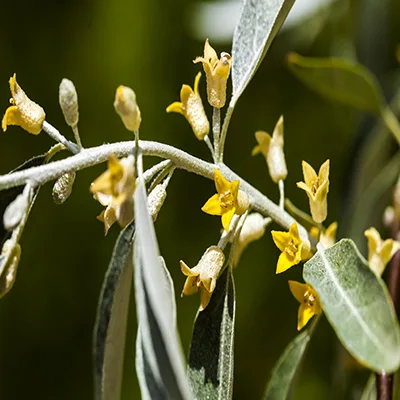
Oleaster (Russian Olive) Blossom
Elaeagnus angustifolia is a deciduous tree. The oleaster (Russian olive) blossoms are applied as a flavoring agent in health tea and food additives.
Benefits & Properties
Common Name: Oleaster, Russian Olive, Silver Berry, Wild Olive, Oleaster (Russian Olive) Blossom
Scientific Name: Elaeagnus angustifolia L.
History and Origin
Elaeagnus has around 90 species worldwide, with the majority of them located in the subtropical areas of Asia, Europe, and North America. (1) The most important medicinal species of this genus is E. angustifolia (Elaegnus tree), (2) which is commonly called Russian olive since its appearance resembles an olive tree with small, reddish-brown, elliptic-shaped fruits. (3) Also, it is called Oleaster in the English language. (2)
Oleaster (Russian Olive) (Elaeagnus angustifolia L.) is a European-Asian tree (2) that can grow under different climatic conditions.
It is a plant that likes the sunlight and can withstand temperatures between 45 and 46 °C. This plant requires shallow-dry, poor or salty soil, and moderate water need for growth. It requires a minimum of 20 cm of precipitation during the year. (4) This tree may thrive in a variety of adverse environmental circumstances, such as floods, severe droughts, stony, sandy, and high salt or alkalinity of the soils. (3) So, it can be important in maintaining ecosystems in arid and semi-arid regions. (5) The Oleaster (Russian olive) is found in northern Asia, the Himalayas, and Europe, (6) particularly in Turkey, Caucasia and Central Asia. Although this species is used as an ornamental tree in many European cities, it is widely cultivated for its edible fruits in Central and Eastern Anatolia. (7) Also, it has different pharmaceutical and economic uses. All parts of the Oleaster (Russian olive) tree, such as the root, wood, bark, flowers, leaves, and fruits, have medicinal properties and are used in the food, sanitary, pharmaceutical, and perfumery industries, (5) as well as in woodwork and musical instrument production. (3)
Oleaster (Russian olive) is commonly grown in China's northwest region, and its blooms have been utilized for both food and medicinal.
For instance, oleaster (Russian olive) blossoms are used as a flavoring agent in health tea and food additives. (8) Moreover, it has been shown that the essential oils of oleaster (Russian olive) bloom and leaves function as natural insecticides in agriculture and as preservatives in the food industry. (9) Flavonoids in oleaster (Russian olive) blossom have good application value in medicine. (8)
Oleaster (Russian Olive) Plant Structure
Oleaster (Russian olive) is a deciduous tree or large shrub from the Elaeagnacea family. It is a long-lived tree (80–100 years) (3) that can grow up to 7 m in height. (4) Its branches are silvery green. (5)
The leaves are 4–8 cm long; (4) they are long elliptic with sharp tips and short petioles. (2) It blooms in June. Oleaster (Russian olive) blossoms have a very sharp and beautiful fragrance. (4) The blossoms are small, a yellowish-white color (3) (cream color), bell-shaped, and single or clustered (5) and have been used as a source of nectar for honey bees. (3) Usually, the flowering season lasts about 20–30 days. (9) Because of the short period of florescence, the raw materials of the oleaster (Russian olive) blossoms must be carefully processed for long-term storage (8) or extracting essential oil. (9) The Oleaster (Russian olive) tree starts to fruit after 5–6 years. (3) The fruits are oval-shaped with a length of 1.5–2 cm, and their colors are reddish-brown. (5) They mature in September and are consumed fresh or dried. (7)
Oleaster (Russian Olive) Blossom Health Benefits
What Are Oleaster (Russian Olive) Blossoms Side Effects?
- Allergy to olive pollen: The pollen of oleaster (Russian olive) blossoms has shown cross-allergic reactivity with olive pollen. So, talk with your healthcare provider if you suspect a known allergy. (16)
- Allergy to oleaster (Russian olive) blossoms: Inhalation of the pollen of an oleaster blossom may cause nasal irritation symptoms in some sensitized people. (3)
Generally, every person may be allergic to certain herbs and spices. This sensitivity must first be diagnosed by the person and, secondarily, by the physician. However, these allergic reactions do not cause chronic or acute side effects, and after identifying the allergenic plant and removing it from the diet, allergy-related complications will be eliminated. No company or product can be aware of the allergic reactions of different bodies in advance. The body's incompatibility with one or more specific herbs rarely occurs, but consumers may encounter it anyway.
Nutritional Information
While specific nutritional information for oleaster (Russian olive) blossoms may be scarce, they are rich in vitamins, minerals, and antioxidants. Further research is warranted to comprehensively understand and quantify the nutritional content of the blossoms. Incorporating these blossoms into your diet can be a delightful way to enhance your nutritional intake and enjoy their potential health benefits.
Oleaster (Russian Olive) Blossom Daily Dosage
The recommended daily dosage for oleaster (Russian olive) blossom infusion is not established because it depends on various factors, such as individual health conditions and the concentration of the herbal tea. However, moderation is typically advised.
Bioactive Compounds
Vitamins: Dried oleaster (Russian olive) blossoms are rich in folic acid (vitamin B9) and cobalamin (vitamin B12). (4) Vitamins A and K are also present in the methanol extract of the flowers of the plant. (17)
Phenolic compounds: Different parts of oleaster (Russian olive), including oleaster blossoms, contain phenolic compounds, and the main phenolic components are gallic acid, catechin, and their derivatives. (1)
Essential oil: The essential oil obtained from oleaster blossoms contains limonene, anethole, ethyl cinnamate, 2-phenyl-ethyl benzoate, 2-phenyl-ethyl isovalerate, nerolidole, squalene, and acetophenone. (18)
Best Time to Consume
1-2 hours before or after meals.
Possible drug interactions
There is insufficient documented data to show the interactions of oleaster (Russian olive) blossoms with other drugs. However, there is a chance that they may react to a few drugs. So, suppose you’re on any medication. Discuss with your doctor if eating oleaster blossoms will interfere with the medicines you are taking.
Traditional Use
- Despite the common perception of the oleaster (Russian olive) tree's disposition as being cold and dry, it should be highlighted that blossoms have been assigned a hot-dry temperament.
- Due to their perceived ability to enhance potency and boost semen production, the blooms are used as an aphrodisiac.
- Oleaster (Russian olive) blossoms are useful against any sort of brain disorder, improve the function of the brain, and provide strength to the brain.
- Oleaster blossoms are considered to be effective against infectious and contagious diseases. (19)
- The flowers are also used for problems with the digestive organs, bowel problems, stomach aches, nausea, vomiting, abdominal distention, jaundice, spleen disease, and a broken spleen. (2, 19)
- It is useful against breathing and lung problems. In addition, it cures kidney disease and malaria. (19)
- Smelling oleaster blossoms is believed to be suitable for paralysis in Iranian traditional medicine. (20)
- The infusion of the flowers has a febrifuge (anti-pyretic) effect. (17)
- Additionally, traditional medicine has utilized the blossoms to cure tetanus. (3)
Some Questions about Oleaster (Russian Olive) Blossoms
References
1. https://link.springer.com/s00217-021-03875-y
2. https://www.ncbi.nlm.nih.gov/PMC4110780/
3. https://www.researchgate.net/295250534
4. https://dergipark.org.tr/tr/2852631
5. https://www.sciencedirect.com/18302905
6. https://www.sciencedirect.com/S0031942214001447
7. https://core.ac.uk/download/227062533.pdf
8. https://www.sciencedirect.com/S0926669023002169
9. https://downloads.hindawi.com/2021/7111120.pdf
10. https://www.alliedacademies.org/pdf
11. https://www.ncbi.nlm.nih.gov/PMC6881950/
12. https://journals.sagepub.com/2156587215595777
15. https://www.ncbi.nlm.nih.gov/PMC7570883/
16. https://www.mdpi.com/2218-0532/74/1/21
17. https://www.ncbi.nlm.nih.gov/PMC5108988