Cornelian Cherry
Discover the natural plants and herbs used in our products
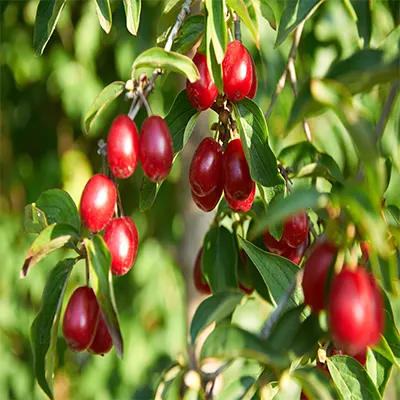
Cornelian Cherry
Cornus mas (cornelian cherry) is a deciduous shrub or small tree. It fruit is a rich source of phenolic compounds, anthocyanin, and ascorbic acid.
Benefits & Properties
Common Name: Cornelian Cherry, Dogwood
Scientific Name: Cornus mas L.
History and Origin
- There are around 65 recognized species in the Cornaceae family's genus Cornus L., most of which grow as bushes and trees. Many species of Cornus L. are cultivated across the northern hemisphere, primarily in Europe, the Caucasus, and Anatolia. Among the Cornus species, four species are known to have edible fruits, namely C. officinalis, C. mas, C. kousa, and C. controversa. (1) The most important fruit is the cornelian cherry (C. mas). (2) This plant originates in the Caucasus foothills and extends over Romania, Bulgaria, Italy, Turkey, and the interior regions of Europe. (3) Also, it is suggested that the first cultivars of cornelian cherry appeared in ancient Greece and Rome. (4) Currently, numerous local cultivars are bred in the temperate zones of Europe and Asia. (4,5) Commercially, the major sources of harvest for this product are Turkey, Iran, Azerbaijan, and Georgia, which are its natural habitats. (3) In Iran, cornelian cherry trees are spread in the western parts of the country (mainly East Azerbaijan and Qazvin provinces). (2) The cornelian cherry is an important plant for food, medicine, and ornamental purposes (6) that contains health-promoting compounds not only in its fruits but also in its anatomical parts (roots, leaves, and flowers). The fruit of the cornelian cherry has a distinct taste, several health advantages, and nutritional qualities. (7) Different products are produced from the cornelian cherry fruit. (2) Cornelian cherry fruit can be consumed dried or fresh (1) as well as an appropriate raw ingredient for the food industry. (7) Cornelian cherry can be used to make various drinks, syrups, and gels. (7)
- The cornelian cherry is a resilient plant that readily adjusts to adverse environmental circumstances. (7) It is rarely attacked by pests and diseases, can be grown with minimal use of chemicals, and does not require much care. For this reason, cornelian cherry is a very lucrative crop. (6)
Cornelian Cherry Plant Structure
Cornelian cherry is a deciduous medium-to-large shrub or small tree that grows up to 5–12 m. (2) The trunk diameter is 25–45 cm. The leaves are lanceolate-broadly elliptical, measuring 3-10 cm in length. They are arranged in an opposing pattern and have short petioles. The inflorescence has an umbrella-shaped structure, measuring 1.5-2.5 cm in height and containing 15-20 flowers. The color of flowers ranges from light yellow to greenish. Unlike other species in the Cornus genus, this particular species distinguishes itself by having the characteristic of flower buds blooming before leaf buds. Cornelian cherry trees begin to flower in early spring. Oval, pear-shaped stone fruits that mature in late summer and early autumn are produced by this species. (8) They are typically light or dark red, but can also be found in pink and yellow, and are sweet-sour. (2)
Cornelian Cherry Health Benefits
What Are Cornelian Cherry Side Effects?
Cornelian cherries have no known or documented side effects. However, we recommend consuming cornelian cherry in moderation and monitoring for any adverse reactions, especially if you have known allergies.
Generally, every person may be allergic to certain herbs and spices. This sensitivity must first be diagnosed by the person and , secondarily, by the physician. However, these allergic reactions do not cause chronic or acute side effects, and after identifying the allergenic plant and removing it from the diet, allergy-related complications will be eliminated. No company or product can be aware of the allergic reactions of different bodies in advance. The body's incompatibility with one or more specific herbs rarely occurs, but consumers may encounter it anyway.
Cornelian Cherry Daily Dosage
The recommended daily dosage for cornelian cherry fruits is not established because it depends on various factors, such as individual health conditions. However, moderation is typically advised.
Bioactive Compounds and Nutritional Information
The chemical composition of the fruits is diverse which are mostly dependent on variety, as well as on cultivation and. conditions related to the environment and climate. (7) Its delicious fruits contain carotenoids, phenolic acids, terpenes, organic acids, and flavonoids (anthocyanins, flavonols), (7) Iridoid, (17) and sugar. (2)
Carbohydrates: Glucose is the primary carbohydrate found in cornelian cherry fruits, with fructose and sucrose following.
Minerals: The fruits contain significant amounts of vital mineral components like calcium, potassium,sodium,and magnesium. Smaller quantities of other minerals, including copper, manganese, iron, phosphorus, and, zinc are also found. (7)
In comparison to other juices derived from plum, pear, and apple, cornelian cherry juice contains a significantly higher concentration of calcium, with a value of 323 mg/L, which is ten times higher than that of other juices which range from 14 to 77 mg/L. (2)
Vitamins: The fruits contain vitamin C, vitamin E, biotin (B7), and riboflavin (B2). (7)
Fresh cornelian cherry fruits, containing twice as much ascorbic acid (vitamin C) as oranges, show their potential as a food additive. (2)
Flavonoids (anthocyanins, flavonols): The primary constituents of flavonoids are flavonol glycosides, particularly quercetin and kaempferol. Cyanidin 3-O-glucoside, peonidin 3-O-glucoside, cyanidin 3-O-galactoside, and delphinidin-3-O-galactoside were the primary anthocyanins found in the fruits. (7)
Iridoids: loganin, loganic acid, cornuside,and sweroside.
Carotenoids: β-carotene, lutein, and luteoxanthin. (1)
Best Time to Consume
1-2 hours before or after meals.
Possible drug interactions
Antidiabetic Medications: Cornelian cherry fruits have the potential to reduce blood sugar levels. Taking cornelian cherry fruits along with medications that also lower blood sugar levels might strengthen the effects of the medications and consequently increase the risk of hypoglycemia. Consult with a healthcare provider before adding cornelian cherry fruits to your diet if you are diabetic.
Antihypertensive Medications: Taking cornelian cherry fruits along with medications that also lower blood pressure might enhance the effects of these medications. Consult with a healthcare provider before adding cornelian cherry fruits to your diet if you have high blood pressure.
Traditional Use
Cornelian cherry is traditionally used in different countries to treat some diseases.
Cornelian cherry is used in Serbia to treat digestive disorders, diarrhea, anemia, and to strengthen the immune system. It is used both preventively and curatively.
In Azerbaijan and Turkey, it is used to cure hemorrhoids and intestinal issues.
Fresh fruit is used as a remedy for colitis, wounds, and stomach ulcers in Caucasian nations.
In China, cornelian cherry is also used to treat diabetes and control renal function.
In Greece, cornelian cherry is used to treat skin conditions, anemia, gout diseases, joint discomfort, metabolic issues, and tuberculosis.
Iranian traditional medicine uses cornelian cherry fruits to treat intestinal inflammation, diarrhea, kidney stones, malaria, fever, urinary tract infections, cancer, and sunstroke. (1)
Some Questions about Cornelian Cherry
References
1. https://dergipark.org.tr/tr/download/article-file/1391821
2. https://www.ncbi.nlm.nih.gov/pmc/articles/PMC4082518/
3. https://www.mdpi.com/1420-3049/29/2/449
4. https://www.researchgate.net/publication/371303887
5. https://www.mdpi.com/2071-1050/14/8/4579
6. https://www.inhort.pl/2004spec2
7. https://link.springer.com/article/10.1007
8. https://www.jrespharm.com/pdf_MPJ_1127.pdf
9. http://asujse.aksaray.edu.tr/en/pub/issue/31151/329856
10. https://www.degruyter.com/tjb-2016-0136/html
11. https://www.cancer.gov/cancer-terms/def/oxidative-stress
12. https://www.mdpi.com/2076-2615/10/12/2435
13. https://www.ncbi.nlm.nih.gov/books/NBK540994/
14. https://www.ncbi.nlm.nih.gov/pmc/articles/PMC3347805/
15. https://www.sid.ir/paper/49809/fa
16. https://www.sciencedirect.com/science/S0034528818353335
17. https://www.ncbi.nlm.nih.gov/pmc/articles/PMC10816641/
18. https://journal.waocp.org/article_89252.html