Mallow
Discover the natural plants and herbs used in our products
Mallow
Mallow is a biennial or perennial and herbaceous plant from the Malvaceae family. Mallow flower tea soothes the sore throat, cough, peptic, and constipation.
Benefits & Properties
Common Name: Mallow, High Mallow
Scientific Name: Malva sylvestris L.
History and Origin
Mallow is a biennial or perennial and herbaceous plant from the Malvaceae family. (1) Mallow has been grown as a medicinal plant and pot herb since Roman times. (2) It is native to Europe, North Africa and Asia. (3) Today the plant can be found in subtropical and temperate parts of the world. (4) Mallow generally grows in moist areas, for instance, near marshes, ditches, oceans, riverbanks, and meadows. (1) Pollination by various flies is critical for the survival and propagation of mallow. (5) Many people consider mallow as a weed. (3) However, it is commonly recognized as a medicinal plant in Europe, Iran, Pakistan and India. (1) The medicinal parts are the dried flowers, the dried leaves and the whole of the flowering fresh plant. (4)
Mallow Plant Structure
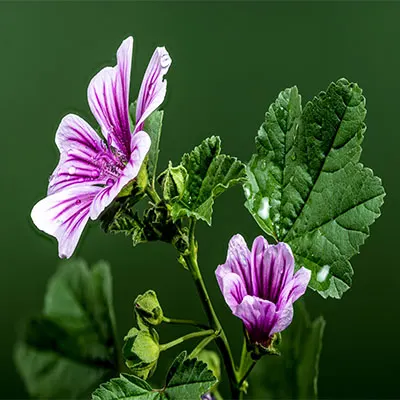
Mallow (or high mallow) is a biennial or perennial leafy herb 0.3 to 1.2 m high. (4) It has delicious annual stem. (5) The stems are branched, slightly woody and roughly pubescent. (4) Mallow is a leafy herb. (4) The leaves are big, spherical, velvety, (5) long-petioled, 5-lobed and crenate-serrate. (4) They are 5-10 cm wide and are green even when dried. (5) Mallow blooms in late spring. (6) The plant has bright purple flowers which have long dark stripes, 5 petals, (4) and are more or less odorless. (5) The dried mallow flowers are purplish-blue. (7)
Mallow Health Benefits
What Are Mallow Side Effects?
- When taken by mouth: The use of mallow at the prescribed therapeutic doses has not shown any health risks or side effects so far. (4) The use of the plant's extract also seems safe for up to 4 weeks; however, it may cause stomach problems such as diarrhea, nausea, and indigestion in some individuals.
- Pregnancy and breast-feeding: There is not enough reliable information to determine whether mallow is safe to use during pregnancy or while breastfeeding. It’s advisable to avoid using it.
- Children: Topical use of mallow is possibly safe for up to 4 weeks. However, there is not enough reliable information regarding its safety for oral consumption in children. (11)
- Generally, every person may be allergic to certain herbs and spices. This sensitivity must be first diagnosed by the person and secondarily by the physician. However, these allergic reactions do not cause chronic or acute side effects, and after identifying the allergenic plant and removing it from the diet, allergy-related complications will be eliminated. No company or product can be aware of the allergic reactions of different bodies in advance. The body's incompatibility with one or more specific herbs rarely occurs, but consumers may encounter it anyway.
Mallow Daily Dosage
Daily Dosage: The average daily dose is 5 gm of mallow flower.
To prepare an infusion, use 1.5 to 2 gm of comminuted mallow flower. Drink it 2 to 3 times daily. (4)
Bioactive Compounds
- Mallow leaves and flowers contain various bioactive compounds such as flavonoids, mucilages, terpenoids, phenol derivatives, coumarins, sterols, tannins, saponins, and alkaloids. (12)
- Mallow leaves and flowers contain high amounts of mucilage which is made up of complex carbohydrates and gives mallow most of its soothing activity, though flavonoids and anthocyanidins may also contribute. (13)
Best Time to Consume
1-2 hours before or after meals.
Possible Drug Interactions
There is insufficient documented data to show the interactions of mallow with other drugs. (14) However, it is possible for mallow to react with a few drugs. So, suppose you’re on any medication; discuss with your doctor if eating mallow will interfere with the medicines you are taking.
Traditional Use
✔The mallow is an important traditional medicinal plant, (5) and its temperament (Mizāj) is considered cold and moist. (15) It can be consumed as a soup, but the majority of people prefer to eat it in salads. (5)
✔Traditionally, various parts of mallow have been used to treat gastrointestinal disturbance (constipation, gastritis, intestinal disorders, stomach ache, and protector of gastric mucous); dermatological ailments (wounds, burns, acne, skin eruptions, urticaria, abscesses, nail infections); hemorrhoidal inflammation; urological disorders (cystitis, bladder pains, prostate ailments, kidney pain and malfunction); respiratory complaints (pectoral emollient, cough, expectorant, spasmolytic and asthma, sore throat and respiratory infections, bronchitis, tonsillitis, mumps); pain (contusions and bruises, menstrual pains); oral diseases (toothache, gingival and mouth inflammation/abscesses, aphthous ulcers); vaginal disorders (infection and itching); as well as other uses such as an anti-anxiety and sedative agent, slimming, high blood pressure, and fever. (3)
✔In Iran, various parts of the mallow plant are used as a cough suppressant, expectorant, lung cleanser, lubricant, anti-swelling, laxative, and immunomodulator.
✔In Pakistan, mallow leaves are used for their relaxing, anti-inflammatory, and diuretic properties, as well as their beneficial effects on gastric mucosa, indigestion, and bladder ulcers.
✔In Algeria, its flower infusion is used as an antiseptic and softening and for the treatment of canker sores, colds, constipation, abdominal pain, asthma, insect bites, swelling, boils, and abscesses.
✔Indians use different parts of the whole plant for treatment of ulceration of the urinary bladder, cough, enlargement of the spleen, jaundice, sore throat, and weak eyesight.
✔Europe uses its aerial parts (including the stems, leaves, petioles, flowers, fruit, and seeds) to treat constipation, diarrhea, and abdominal colic.
✔Its leaf decoction or infusion is used to treat bronchitis, weight loss, colds, coughs, cystitis, and belly pain in Italy.
✔People in Lebanon use the leaves and flowers of the mallow plant to treat rheumatism and joint inflammation (such as osteoarthritis).
✔Syrians also use them as a laxative, mouthwash, and to treat respiratory infections and coughs. (1)
Some questions about Mallow
References
1. https://onlinelibrary.wiley.com
2. https://www.thieme-connect.com
3. https://onlinelibrary.wiley.com
4. PDR for herbal medicines. (2000). 2nd ed. Montvale, NJ: Medical Economics Company
5. https://www.researchgate.net
7. Ghassemi Dehkordi, N., Sajjadi, S.E., Ghannadi, A., Amanzadeh, Y., Azadbakht, M., Asghari, G.R., … Taleb, A.M. Iranian Herbal Pharmacopoeia (IHP).
8. https://www.sciencedirect.com
9. https://journals.sagepub.com
12. https://www.ncbi.nlm.nih.gov.
13. https://www.researchgate.net